
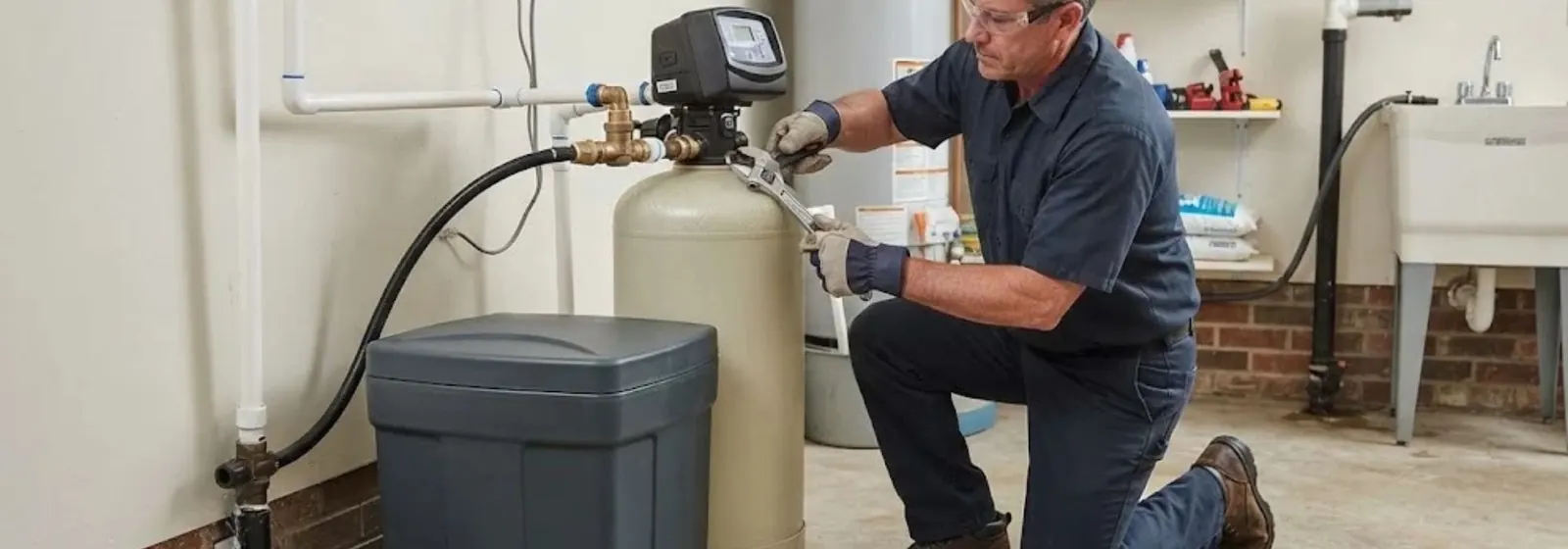
DIY water softener installation means setting a resin tank and brine tank near your main water line, connecting them to the supply pipe, running a drain line and plugging in the control head. The mechanical steps are simple. The planning around them is what trips people up.
Before you carry a 100 pound unit into the basement, two questions come first. Does your water actually need softening, and does your layout leave room for a bypass, a drain and an outlet? A wrong answer to either costs far more than the unit.
This guide covers testing, the parts involved, pipe materials and connection methods, the drain air gap and the point where hiring out is the smarter move.
Test your water before you buy anything
Start with a hardness test. Hardness test strips from a hardware store give a rough reading, and a lab test or your water provider's report is better. Results come in grains per gallon or mg/L, and one grain per gallon is about 17 mg/L.
The USGS classes water under 60 mg/L as soft and 121 to 180 mg/L as hard, with a moderate band between. Hardness is not a health concern. It causes scale on fixtures, spotty glassware and chalky taste, and it can shorten the life of a water heater when scale builds on the heating surface.
Test the tap you plan to treat, ideally the cold line at the main. Write the number down, since the softener's capacity and salt setting depend on it. A reading in the soft or moderate range may mean you do not need a softener at all.
Installing a softener in four moves
Shut off and drain
Close the main valve, open a faucet at the lowest level and let the lines empty before you cut anything.
Set the unit
Place the resin tank on a level pad near the main, within reach of a drain and a grounded outlet.
Plumb the loop
Install the bypass valve, connect inlet and outlet, and keep the arrows on the valve pointing with the flow.
Drain and start
Run the drain line through an air gap, add salt, plug in the control head and flush air from the system.
Read the manufacturer's manual before you start, since each model has its own order for flushing and programming. Open the cold supply slowly afterward and check every joint for drips. A pinhole spray shows up quickly under pressure, and it is much easier to fix before the walls are closed.
Soldering vs push-fit vs PEX connections for the hookup
| Method | What you need | Watch out for |
|---|---|---|
| Soldered copper | Torch, flux, solder, cleaning tools | Open flame near framing, plus a fully dry pipe to get a good joint |
| Push-fit fittings | Pipe cutter, deburring tool, depth gauge | Square cuts and full insertion, or the joint can leak |
| PEX with clamps or crimps | PEX tubing, rings, matching tool | Using the right ring size and a gauge on every joint |
| Flexible braided connectors | Two connectors and adapters | Kinks, pressure ratings and routing without strain |
For most homeowners push-fit or braided connectors are the practical choice. They need no flame, which matters because soldering near wood framing, insulation or an unfinished wall is a real fire risk. If your main line is old galvanized pipe, the work gets harder, and that is a good reason to call a plumber.
Drain line, air gap, salt and the electrical outlet
A softener regenerates by flushing brine through the resin, and that wastewater has to go somewhere. The drain hose or pipe should end above a floor drain, laundry standpipe or utility sink. Leave an air gap, typically at least an inch, between the hose end and the drain so sewer water cannot be pulled back into the unit.
Salt comes in pellets, crystals or blocks, and the brine tank usually takes bags of 40 pounds. Keep the level above the water line and avoid bridging, where a crust forms over the salt and leaves an empty cavity beneath. Break up crusts with a broom handle if you see one.
The control head needs a standard grounded outlet within reach of its power cord. Do not wire a new circuit or use a cord that stretches across a wet floor. If you lack an outlet near the main, an electrician is the right call, not an extension cord.
Model codes such as the UPC and IPC set how piping, venting and fixtures are installed, though the version in force can differ by jurisdiction, so check with the Building Division before work starts.
DIY install vs hiring a plumber
DIY can work when
- The main is copper or PEX and easy to reach
- A drain and a grounded outlet sit close by
- You can shut off, cut and reconnect without a torch
- You are comfortable lifting about 100 pounds
Hire out when
- The pipe is galvanized, corroded or hard to access
- No drain, outlet or room is near the main
- You need a new line or a rerouted supply
- You want a permit and inspection handled for you
Plumbers handle the cut-in, the bypass and the drain, and they can test for leaks under pressure before they leave. Our water softener and filtration page lists what we install, and a new softener loop often counts as plumbing installation work.
Wheat Ridge note: test your tap before you buy a softener
Denver Water has said in its hardness article that customers may not need a softener, and it urges owners to maintain any softener properly. It also tells buyers to contact the utility and research a device before they buy, noting that sales scams have occurred. The same article says its southern collection system is moderately hard at about 75 to 120 mg/L, and its northern system is softer at typically 40 to 50 mg/L.
Wheat Ridge is served by more than one provider, including Denver Water, Consolidated Mutual, Valley Water and Wheat Ridge Water District. The city does not say which one serves your address, and the Denver Water article does not say which system feeds Wheat Ridge. So check your water bill, ask your provider which Denver Water system feeds your street, and then test your tap.
Next door, the City of Arvada says its water is soft to moderately hard, ranging from about 20 to 100 mg/L and averaging 84 mg/L, and that softeners are not needed. The city notes that softeners swap calcium for sodium and can increase plumbing corrosion. If you live near the border, our Arvada plumbing page covers that side, and the service area page lists the other towns we serve.
Common questions
Do I need a softener in Wheat Ridge?
Possibly not. Hardness varies by provider and street, and Denver Water says many customers may not need one. Test your tap, compare the result to the soft and hard ranges, and ask your provider before you buy.
What is a bypass valve and do I need one?
A bypass valve lets you send water around the softener for service or a water-heater flush without shutting off the house. Most units come with one, and installing it makes later repairs far less stressful.
Why does the softener need a drain with an air gap?
Regeneration dumps briny wastewater, and the air gap keeps drain water from being drawn back into the unit. Without the gap, a clogged drain could contaminate the softener.
Can a softener damage my plumbing?
Softened water has more sodium and can be more aggressive toward some metals, as the City of Arvada notes. Settings matter, so keep the hardness setting accurate, and do not over-soften. A plumber can review your pipes if you are unsure.
Does a DIY softener install need a permit in Wheat Ridge?
Permit rules vary, so ask the Wheat Ridge Building Division at (303) 235-2855, option 1. Colorado allows the homeowner to install plumbing on their own property, but unregistered others may not do it for you.
What if the install leaks or the unit will not regenerate?
Shut the bypass, check each joint and the drain line, then read the manual's troubleshooting guide. If a leak persists or you cannot find it, call (303) 552-3896 and a licensed plumber can take a look.