
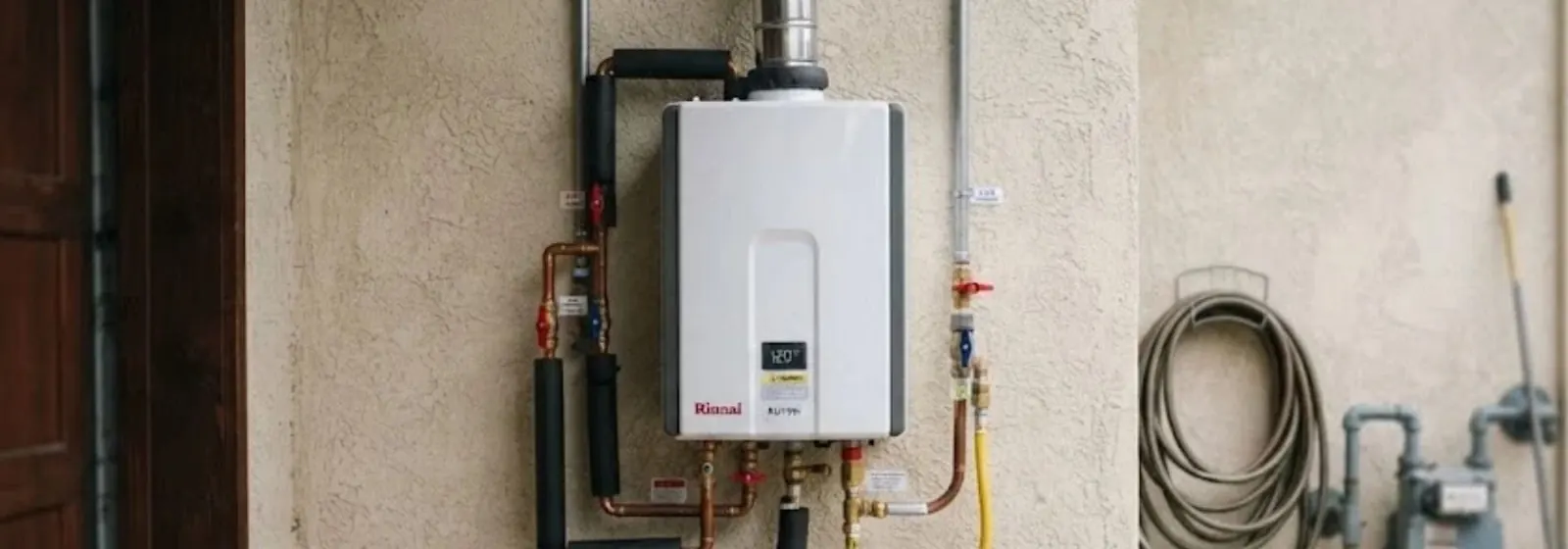
A tankless water heater in Wheat Ridge heats water on demand through a heat exchanger, with no storage tank to keep warm. Cold water enters, a burner or electric element fires, and hot water leaves at a set temperature. We install, repair and service these units, including the yearly flush that keeps them healthy.
Tankless units often last 15 to 20 years with maintenance, longer than most tanks. They also have more to maintain, including an inlet screen, a heat exchanger, sensors and a condensate trap on high-efficiency gas models. Skipping service is the most common reason they fail early.
Tankless flush and descale service
Minerals in water form scale inside the narrow passages of a heat exchanger. A thin layer reduces heat transfer, so the unit works harder, runs hotter and throws error codes. Left alone, scale restricts flow until the unit shuts down.
A flush circulates a descaling solution, often white vinegar or a manufacturer-approved product, through the unit with a small pump and two hoses. The job uses the service valves on the inlet and outlet, which is why we add isolation valves to units that lack them. After the flush, we clean the inlet filter screen, rinse the unit and check the gas pressure and combustion.
Most manufacturers suggest flushing at least once a year, and more often in harder water. If your unit has never been flushed, plan one soon. A heavily scaled exchanger may not recover fully, and replacement of the exchanger or the unit can follow.
Hard water facts for Wheat Ridge tankless owners
Denver Water says its supply is mostly snowmelt, with a southern collection system that is moderately hard at about 75 to 120 mg/L and a northern one that is softer at typically 40 to 50 mg/L. Hardness runs slightly higher in winter. Its article does not say which system serves Wheat Ridge.
Wheat Ridge is served by several providers, and Wheat Ridge Water District buys its water from Denver Water. So ask your district which Denver Water system feeds your street, then test your tap. The result tells you how often to flush. Hardness is a nuisance, not a health risk, and Denver Water says many customers may not need a softener.
Tankless unit throwing codes?
Note the code and call. We can often clear scale the same day.
Signs your tankless heater needs attention
Tankless units usually warn you before they quit. Watch for these patterns.
Cold sandwich
A burst of hot water, then cold, then hot again. This points to flow sensor trouble, scale or a minimum-flow issue.
Error code on the display
Codes cover ignition, venting, flow and overheating faults. Note the number and the pattern before calling.
Rumbling or popping
Scale on the exchanger can boil tiny pockets of water and cause noise.
Lower hot water flow
A clogged inlet screen or partly scaled exchanger cuts the flow rate.
Unit shuts off mid-use
Overheat protection, a blocked vent or low gas supply may be tripping it.
Tankless water heater installation and sizing
Sizing starts with two numbers: the flow rate in gallons per minute and the temperature rise you need. Two showers plus a dishwasher may need 7 to 9 gallons per minute. Water colder in winter needs more heating power for the same flow, so we size for the coldest season.
A gas tankless unit usually needs a larger gas line than the tank it replaces, plus sealed venting through a wall or roof. Electric models need heavy circuits, sometimes more than a panel can spare. We check these before quoting, and permit rules vary, so ask the Wheat Ridge Building Division about your swap.
Tankless or tank water heater
Tankless
- Hot water does not run out on long showers
- Compact wall-mounted footprint
- Often lasts 15 to 20 years with service
- Needs yearly flushing and larger gas or electric supply
Tank
- Simpler venting and connections
- Lower upfront parts and install work
- Often lasts roughly 8 to 12 years
- Limited hot water until the tank recovers
Neither wins everywhere. A large household with a long run to the bathroom may like tankless, while a small household with limited gas capacity may prefer a tank.
How a tankless repair visit works
Read codes
We pull the error history and ask when the fault appears.
Check inputs
We test gas pressure or power, water flow, the inlet screen and the vent.
Fix or flush
Scale gets flushed. Failed igniters, sensors or fans are replaced.
Verify
We run hot water at several fixtures and confirm steady temperature.
Safety steps before any tankless work
Gas models need correct venting, so if you smell gas, leave the building, call 911 and the gas utility, and do not switch anything on or off. Electric models draw heavy current, so keep the breaker off while any cover is removed.
When to call a plumber: error codes that repeat, water that swings hot and cold, or exhaust staining near the unit. Do not run a gas unit with a damaged vent.
Repairs we handle and honest limits
We service igniters, flame rods, flow sensors, thermistors, fans, condensate traps and inlet screens on gas and electric units. We also add isolation valves for flushing.
Some faults need a sealed heat exchanger or control board that costs close to a new unit. When that happens, we lay out repair against replacement and let you decide. Unit age and condition matter in that call.
Plumbing work is generally written against model codes such as the UPC and the IPC, and the adopted edition and local changes vary, so ask the Wheat Ridge Building Division which rules apply to your job. Any dedicated circuit follows the National Electrical Code (NEC) as adopted locally, so the electrical permit is separate from the plumbing one.
What affects the price of tankless service and installation
A flush is a smaller job than a repair, and a repair is smaller than a new install. The size of the unit, how scaled it is, whether valves exist and how hard the vent or gas work is all change the price. After-hours calls can also change it.
Call (303) 552-3896 to describe your unit, and we give a clear price before work starts. Our emergency line is open 24/7 if a unit fails and leaves you cold.
Common questions
How often should a tankless water heater be flushed?
Many manufacturers suggest yearly. Harder water may call for more often. Testing your tap tells you how hard your supply is.
Can I flush my tankless heater myself?
Some owners do it with a pump, two hoses and vinegar if isolation valves are installed. Without those valves, the job is difficult. Gas units should be off while you work.
Do I need a water softener with a tankless heater?
Not always. Denver Water notes that customers may not need one. Ask your district about hardness, test your tap and compare with the unit's manual.
Why does my water go cold briefly in the middle of a shower?
This is often a minimum-flow issue, a flow sensor fault or scale. We trace which one by testing flow and temperature at the unit.
Can you replace a tank with a tankless unit?
Usually, but gas line size, venting and electrical capacity must be checked first. Our team reviews those on site.
Do you service units installed by other companies?
Yes. We service most gas and electric tankless units, though some parts may take time to source.
Can landlords schedule tankless service for a tenant's unit?
Yes. Property managers can arrange access and approve the price in advance.
Where this fits with other work
If your unit is not worth saving, see planned water heater installation for sizing and permit steps. For a tank that failed overnight, water heater repair is the place to start.
Scale also builds up in other fixtures, and water softener and filtration options are worth a look. Homes in nearby Arvada are covered through our Arvada page.