
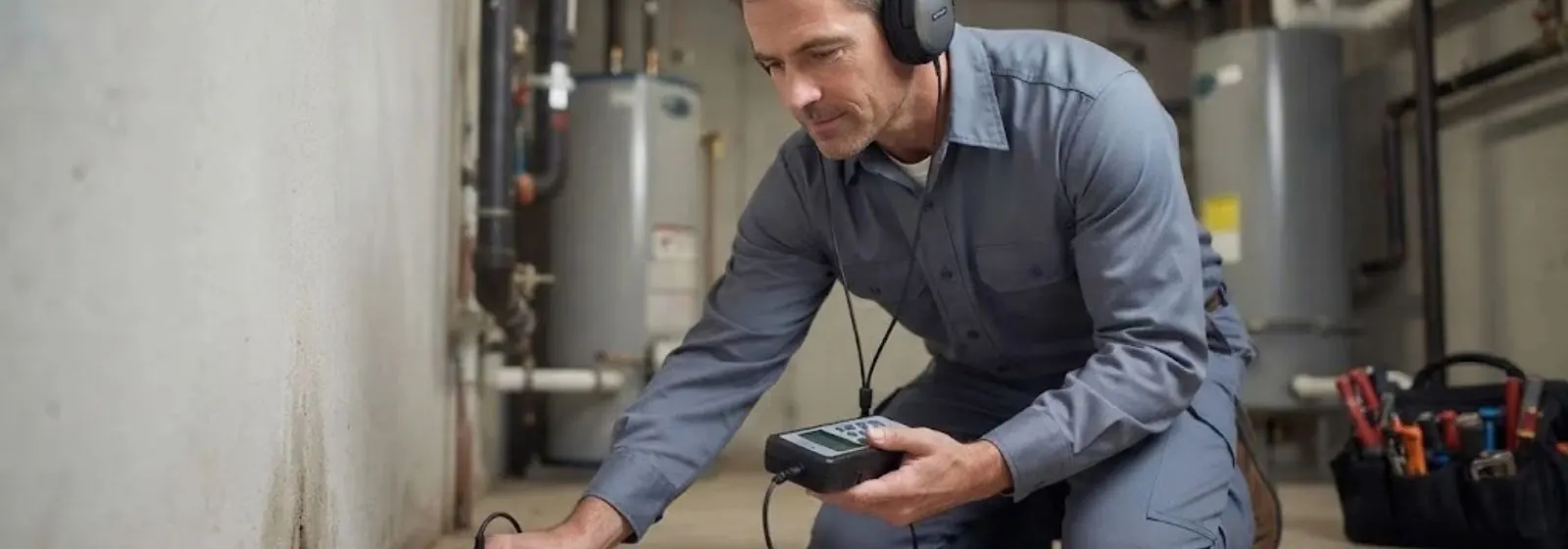
Leak detection is the process of finding the exact spot where a pipe is losing water, usually behind a wall, under a slab or in the ground. If you are in Wheat Ridge and water is actively pouring, we answer the emergency line 24 hours a day, every day of the year.
While you wait, find your main shutoff valve and turn it clockwise until it stops. Then open one faucet at the lowest point of the house to drain the pressure. If water is near outlets or a panel, stay out of the room and leave the power alone.
When a hidden leak is an emergency
Call right away if water is coming through a ceiling, if a floor feels soft or warm underfoot, or if you hear water running when every fixture is off. A ceiling that bulges or drips can drop a large section of drywall without warning.
- Shut off the main water valve and open a low faucet to relieve pressure.
- Move furniture, rugs and electronics away from wet floors and walls.
- Place a bucket under any ceiling drip and poke a small hole in a bulging bubble to let it drain.
- Photograph the damage for your insurance company before you clean up.
Meter still running or a high water bill
A bill that jumps while your habits stay the same is the most common sign of a hidden leak. The meter is your best witness, and you can read it yourself.
Turn off every faucet, the dishwasher, the washer and the ice maker. Open the meter lid and find the small leak indicator, often a triangle or tiny wheel. If it spins with everything off, water is escaping past the meter. For a second check, note the dial, wait an hour and read it again.
Next, close your main shutoff and watch the dial. If it stops, the leak is inside the house. If it keeps moving, the leak is in the buried line between the meter and the house. A running toilet is the usual suspect, so try food coloring in the tank first.
Water running where it should not?
Call the 24/7 line and we will start with your meter.
Slab leak signs to watch for
Warm spots on the floor
A hot water line leaking under concrete can warm one patch of tile, wood or carpet while the rest stays cool.
The sound of running water
You hear a faint hiss or trickle at night with every fixture closed, often loudest when you press an ear to the floor.
A sudden bill rise
Usage climbs within a single billing cycle and the meter indicator keeps turning with everything shut off.
Leaks in ceilings and walls
A brown ring on a ceiling or a soft, cool wall usually points to a supply line, drain or fixture seal above. Water travels along joists and the back of drywall, so the stain is rarely under the source.
We start with a moisture meter and a thermal imaging camera, which shows temperature differences behind the surface. Wet areas look cooler than dry framing, so we cut one small inspection hole instead of opening a whole wall.
Under-house, crawlspace and basement leaks
Pipes under a house are easier to reach. We look for drips on supply lines, rusted fittings, wet insulation and stained joists, and in a basement we check the foundation wall, the water heater and the main line entry.
Not every damp basement is a plumbing leak. Condensation on cold pipes or a failed sump pump can look the same, so we run a pressure test on the supply side and you pay only to fix the real problem.
Underground and buried line leaks
The service line from the meter to your home is buried, often under a lawn, driveway or planting bed. Clues include a soggy patch that never dries, low pressure at every tap and a meter that moves with the house shut off.
We locate the break with acoustic listening gear, which picks up the hiss of escaping water. On long runs we sometimes add tracer gas, which rises through soil where the pipe is open. Digging requires a call to Colorado 811 at least three business days ahead.
How we find a leak without guessing
Interview
We ask what you have noticed, then read your meter and check the main valve and pressure.
Isolate
We close off zones of piping to learn whether the leak is on the hot side, the cold side or the buried line.
Pinpoint
We use acoustic listening, thermal imaging, a moisture meter or tracer gas to mark the exact spot.
Explain
You get a clear price for the repair and a plan for opening the smallest possible area.
Which detection method fits which leak
| Situation | Method we typically use | What it tells us |
|---|---|---|
| Meter moves with everything off | Meter test and pressure test | Whether the leak is inside the house or in the buried line |
| Warm floor or sound of running water | Acoustic listening and thermal imaging | Where a slab pipe is losing water |
| Stain on a ceiling or wall | Moisture meter and thermal camera | The wet path and the likely source |
| Wet lawn between meter and house | Acoustic gear and tracer gas | The point of the break along the service line |
Irrigation, pool and yard leaks
Irrigation leaks hide in valve boxes, at sprinkler heads and in buried lateral lines. A zone that stays wet or a head that gushes points to a break, and we can pressure test the zone and trace the line.
Pools and spas lose water to evaporation too, so a bucket test comes first. If the pool drops faster than the bucket, we test the skimmer, return lines and equipment pad. Shell cracks belong to a pool specialist.
The meter box in your yard can leak at the connection or shutoff. If water pools in the box or the meter runs after you close the house valve, call us. The meter belongs to your water provider, so we say when the repair is theirs.
Who to ask about water in Wheat Ridge
The city does not supply water, and four providers serve the area: Denver Water, Consolidated Mutual, Valley Water and the Wheat Ridge Water District. Your latest water bill names yours, so check it before you call anyone about a spike.
Ask your provider for a usage history, since a month by month record shows when a leak started. We see this work in 80033, 80034 and the nearby 80212, 80214 and 80215 ZIP codes.
Pipe sizing, venting and trap rules come from model plumbing codes like the UPC and IPC, which each city adopts in its own form, so permit rules vary and the Building Division has the answer.
What affects the price of leak detection
Detection is usually priced apart from the repair. A leak at an exposed basement fitting costs far less than one under a finished slab or along a long buried line.
A sudden pipe failure that damages your home may be covered by insurance, but gradual leaks and maintenance usually are not. Call (303) 552-3896 and we will explain the price before work starts.
Common questions
Do you handle leak detection emergencies at night or on weekends in Wheat Ridge?
Yes. The emergency line is open 24/7, including nights, weekends and holidays. For an active leak the dispatcher tells you how to shut off water while you wait.
How do I know if I have a slab leak?
Common clues are a warm floor patch, a faint running sound with fixtures off and a sudden bill jump. Two or three together make a slab leak likely.
Do you have the equipment to find a leak behind a wall?
Yes. We use acoustic listening gear, thermal imaging, moisture meters, tracer gas and pressure testing, chosen by the pipe and what surrounds it.
Will you have to cut into my walls or floors?
Only as little as needed. Tracing narrows the leak to a small area, and you see the plan and price before we cut.
Can a leak be fixed without digging up my yard?
Sometimes. An exposed fitting is a simple repair, but a buried break usually needs a small excavation after the 811 call.
I manage rental property. Can you check a tenant's unit for a leak?
Yes. We coordinate access with the tenant and explain what we found for your records.
Will my water bill drop after the leak is fixed?
It should return to its normal range next cycle. Ask your provider whether it reviews usage after a documented repair.
Where this fits with other work
A buried leak between the meter and the house is covered in more detail on our water line repair page, and a pipe that has already failed suddenly is handled under burst pipe repair.
We also dispatch from Wheat Ridge to neighbors north of us, so homeowners in Arvada can reach the same leak tracing service.