
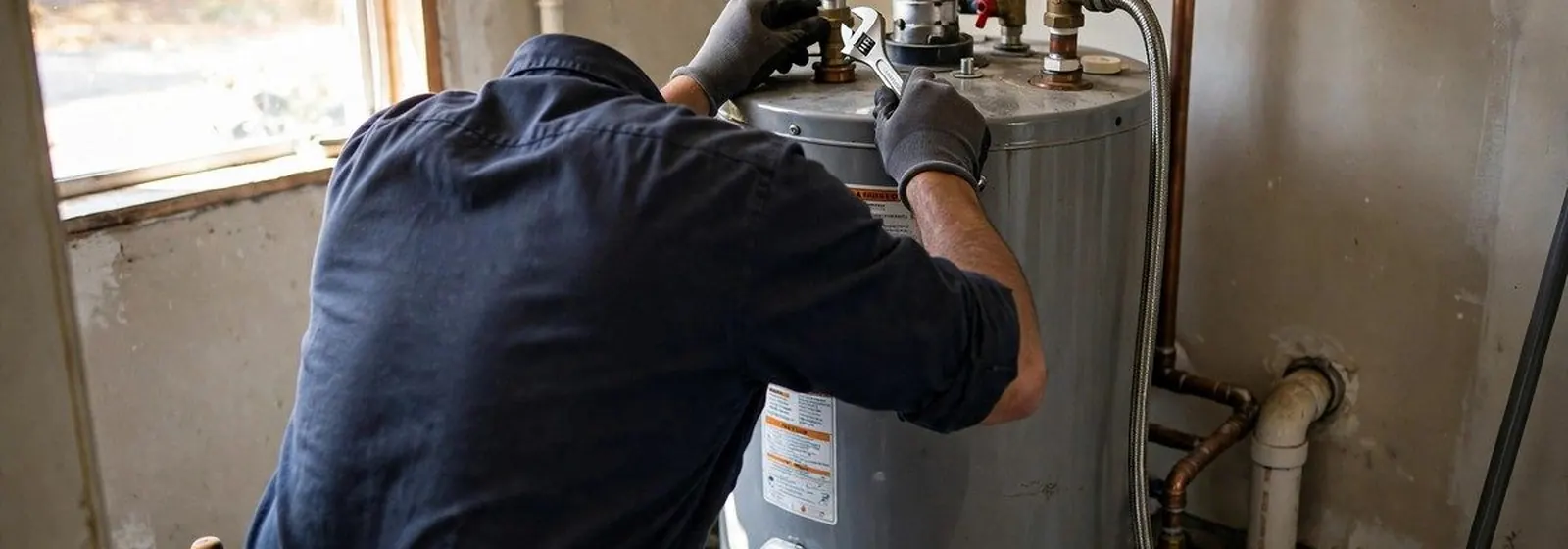
Emergency water heater repair in Wheat Ridge means a licensed plumber finds out why your tank is leaking, tripping, rumbling or running cold, then fixes the part that failed. We answer the 24/7 line at any hour, including nights, weekends and holidays. While you wait, the steps below keep a small problem from soaking the floor.
A water heater is a pressure vessel with a few moving parts: a heat source, a thermostat or gas control, a dip tube, an anode rod and a relief valve. Most failures start in one of those parts. Some are cheap to fix on the spot. Others, like a rusted-through tank shell, are not repairable, and we will tell you that plainly.
We work on atmospheric gas tanks, power-vent units, standard electric tanks and hybrid heat pump models, and you hear the price before any work begins.
When a leaking water heater is an emergency
Water pooling around the base, a scorching smell, or a relief valve that will not stop running all need action right away. A tank can hold 40 to 50 gallons, and a failing seam can empty most of that onto your floor in a short time.
If you smell gas near a gas-fired unit, leave the building first, then call 911 and the gas utility from outside. Do not flip switches or look for the source yourself.
- Turn the cold-water supply valve above the tank clockwise until it stops.
- Switch the heater off: set a gas control to pilot or off, or flip the electric breaker.
- Move boxes, rugs and stored items out of the water's path.
- Open one hot tap upstairs to relieve pressure, and keep children and pets clear of hot puddles.
- Call the 24/7 line and describe where the water is coming from.
Where a water heater leak shows up first
A water heater leak rarely announces itself with a gusher. It usually starts as a damp patch or a slow drip, and the location tells us a lot about the cause. Take a flashlight and look before you call, so you can describe what you see.
Puddle at the base
Water collecting under the tank often points to a corroded shell or a failed lower seam. If the tank itself is leaking, repair is usually not possible and replacement is the safe route.
Wet slab or garage floor edge
Dark staining or a damp line where the slab meets the wall can come from a slow seep that has run for weeks. Check cardboard and boxes stacked nearby, because they wick moisture upward.
Dripping T&P valve
The temperature and pressure relief valve opens when pressure or heat climbs too high. A steady drip may mean thermal expansion in a closed system, a worn valve seat or genuinely excessive pressure.
Dripping fittings on top
Water running down the jacket from the inlet and outlet connections often comes from a loose union or a worn dielectric nipple. These are far more repairable than a tank leak.
Tank leaking right now?
Shut off the water and power, then call the 24/7 line.
No hot water, lukewarm water or short showers
Running out of hot water mid-shower has a short list of causes. Think of a tripped breaker, a failed element, a dead thermostat, a pilot that will not stay lit or a broken dip tube that lets cold supply water mix at the top.
Tell us whether the water is fully cold, lukewarm or just running out fast. Fully cold on an electric unit often means a tripped high-limit switch or a dead upper element. Lukewarm with a short supply points to a lower element or heavy sediment.
Repairing gas, electric and hybrid water heaters
Each type of tank fails in its own way, so the diagnosis starts with what powers the unit.
Gas tanks depend on a thermocouple, a gas control valve and a clear flue. A pilot that keeps going out, yellow flame or soot near the draft hood needs attention soon, because the venting path matters for safety. Power-vent models add a blower and pressure switch that can fail separately.
Electric tanks use two 240-volt elements controlled by thermostats. We test each element with a multimeter for continuity and resistance before replacing anything. Hybrid heat pump units add a compressor, fan and condensate drain, and they hold a backup element. They are worth diagnosing carefully, since a clogged condensate line looks like a leak but is not a tank failure.
Anode rod, sediment and why tanks wear out
Inside every steel tank sits an anode rod, a sacrificial metal bar that corrodes so the tank wall does not. Once the rod is used up, the shell starts to rust. Checking and swapping a worn rod can add years to a tank that is otherwise sound, though a rod stuck for a decade can be hard to remove.
Sediment is the other slow killer. Minerals settle on the tank floor and insulate the water from a gas burner, which causes rumbling, popping and overheating of the steel. On electric units, sediment buries the lower element and burns it out. Flushing the tank on a regular schedule slows this, and we can show you the drain valve.
Who to call about the water side in Wheat Ridge
Wheat Ridge is a limited-service city, so the city itself does not supply your water. The city's own page lists four providers: Denver Water, Consolidated Mutual, Valley Water and Wheat Ridge Water District.
That matters during a leak call. If water is escaping before your house shutoff, near the meter or service line, the provider typically handles it. If it is on your side, at the tank or its piping, it is ours. Check your water bill to see which provider you have, and keep their number near the shutoff.
Model codes such as the UPC and IPC set how piping, venting and fixtures are installed, though the version in force can differ by jurisdiction, so check with the Building Division before work starts. Any dedicated circuit follows the National Electrical Code (NEC) as adopted locally, so the electrical permit is separate from the plumbing one.
What happens during a water heater repair visit
Triage
We stop active leaks, shut off power or gas and protect the surrounding area.
Diagnose
We test controls, elements or burner parts and inspect the tank shell, fittings and venting.
Quote
You hear what failed, what it takes to fix it and the price before any work starts.
Repair and test
We replace the failed part, restore power or gas, then check for leaks and proper temperature.
Repair the part or retire the tank
| What you see | Likely cause | Typical direction |
|---|---|---|
| Water from the top fittings | Loose union or worn nipple | Repair |
| No heat on one element | Failed element or thermostat | Repair |
| Pilot will not stay lit | Thermocouple or gas control | Repair |
| Puddle that grows at the base | Tank shell failure | Replace |
What affects the price of water heater repair
The price depends on which part failed, how easy it is to reach and whether the unit is gas, electric or hybrid. A thermostat or element swap is a smaller job than a gas control valve or a power-vent blower. After-hours calls and hard-to-reach installs can also change the number.
Water damage from a sudden tank failure may be covered by homeowner's insurance, while a slow leak that ran for months and routine wear usually are not. Call (303) 552-3896 and we will explain the price before we start.
Common questions
Do you handle water heater repair emergencies at night or on weekends in Wheat Ridge?
Yes. The emergency line is open 24/7, and a licensed plumber can be dispatched for active leaks, no-heat failures and relief valve problems. Same-day appointments are available when the schedule allows for less urgent faults.
Can you stop a leaking water heater without replacing it?
Sometimes. A leak from a fitting, valve or element gasket is a repair. A leak through the tank wall cannot be sealed, and we will explain why before suggesting a new unit.
Why is my T&P valve dripping?
The valve opens when pressure or temperature gets too high. Causes include thermal expansion with no expansion tank, high supply pressure, an overheating thermostat or a worn valve. We test pressure first, because replacing the valve alone may not cure the cause.
How long should a tank water heater last?
Tanks often last roughly 8 to 12 years, depending on sediment, anode rod condition and water quality. A unit near that range with repeated problems is a candidate for replacement.
Do you repair rental properties for landlords and property managers?
Yes. Property managers can call the same line for tenant emergencies. We can coordinate access with the tenant, and the price is stated before work begins.
Where this fits with other work
If the diagnosis shows a worn-out tank, see our water heater replacement page for sizing and venting questions. Planning ahead instead of reacting to a failure? Our planned installation visits cover permits and expansion tanks.
A leak that does not come from the heater may need leak detection to find the real source. We also serve homes just north of us, so Arvada residents can use the same 24/7 line.