
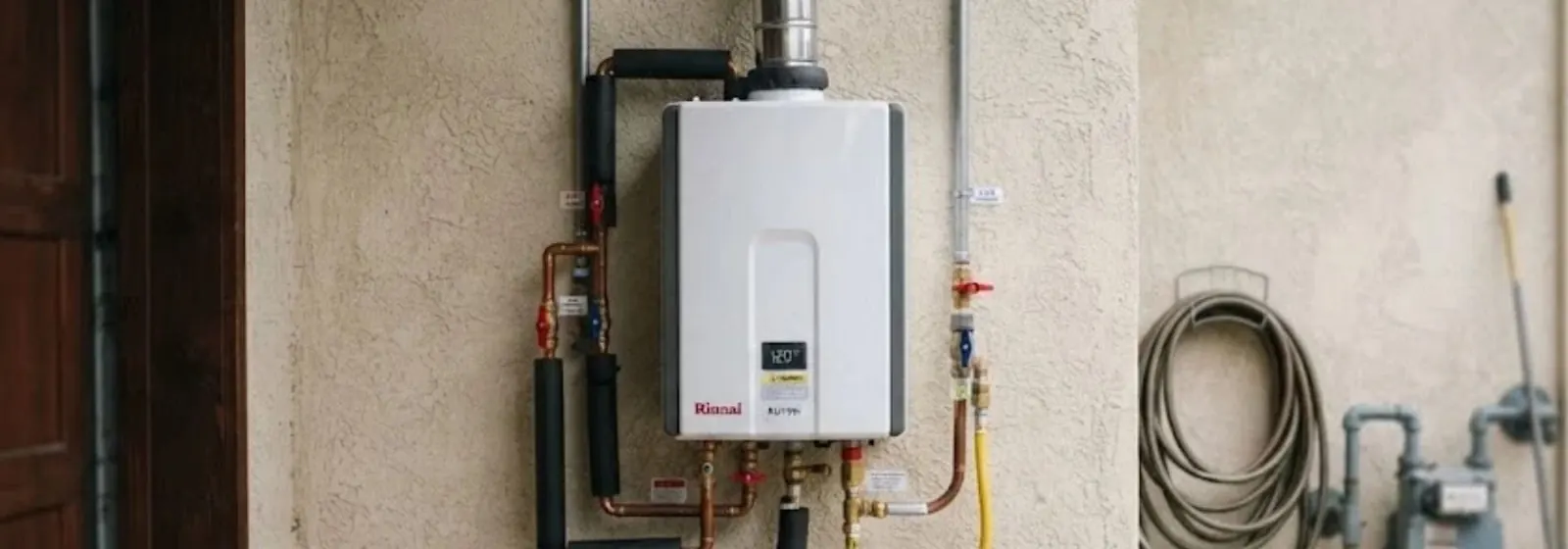
People searching for an Eco Smart 18 tankless water heater are usually looking at an electric tankless model sold under the EcoSmart name in the 18 kW class. This page does not quote the manufacturer's specifications, flow rates, prices or availability, because those change by model year and you should read them off the unit.
What a plumber can tell you is how electric tankless heaters of this size behave in a house. They heat water on demand with heating elements, they draw a large amount of power while running, and they have limits on how much water they can warm at once.
Use this guide as a checklist for a tankless water heater purchase. The label and installation manual on your exact unit always come first, and a licensed electrician must confirm that your electrical service can carry the load.
What an 18 kW class electric tankless heater needs
Power is the first question. A load of 18 kilowatts at 240 volts works out to roughly 75 amps of continuous draw by simple arithmetic. That is only a rough figure for planning. Wire size, breaker size and how the unit splits across circuits depend on the manual and the local electrical rules.
Many homes with 100 amp service have limited spare capacity, especially if there is already an electric range, dryer or air conditioner. A licensed electrician should run a load calculation before you buy, because an undersized service may mean a panel upgrade, which can change the project size a great deal.
Wire gauge is not a DIY guess. Heavy copper conductors, correct breakers and a disconnect where required are all details for a licensed electrician. A plumber handles the water side and coordinates the schedule with the electrical work.
Flow and temperature rise: the limit nobody mentions
Every electric tankless heater is limited by how many degrees it can raise the water at a given flow. The relationship is simple physics. A fixed amount of power can heat a smaller stream by a large amount or a bigger stream by a smaller amount.
As a rough illustration only, 18 kW of heating can lift about 2 gallons of water per minute by roughly 60 degrees. That is arithmetic, not a claim about any product. Your unit's rated performance is on its data label and in its manual, and those are the numbers to use.
Two showers at once, a dishwasher and a running laundry sink can ask for more than one unit can deliver. When demand exceeds capacity, the water simply comes out cooler, which feels like the heater is failing even though it is working as designed.
Electric tankless or a regular tank: what changes
Electric tankless
- Heats on demand, so no standby loss from a stored tank
- Compact and wall mounted, freeing floor space
- Needs heavy electrical capacity and a panel check
- Output drops with colder inlet water or heavy demand
Tank heater
- Stores a full tank, so overlapping uses are easier
- Simpler electrical or gas needs in many homes
- Takes up more floor space and loses some heat when idle
- Often lasts roughly 8 to 12 years, with tankless units often longer
Tankless units often run 15 to 20 years with maintenance, according to general industry experience. That longer life is part of the case for tankless, but only if the electrical service and plumbing can support it from day one.
Questions to ask before you order the unit
What does the label say?
Read the rated power, voltage, amperage and maximum flow on the model you plan to buy, and get the installation manual before you commit.
Can the panel handle it?
Ask a licensed electrician for a load calculation and written confirmation that your service and wiring path work.
How many fixtures at once?
Count simultaneous showers, tubs, dishwashers and laundry. Compare that to the unit's rated flow at your winter inlet temperature.
Where will it mount?
Look for a wall that is solid, near the panel and reachable for service, with room around the unit as the manual requires.
Does the warranty depend on installation?
Read the warranty terms in the manual. Some require a licensed installer, and some are affected by water hardness.
Installation realities
A tankless install is not a quick tank swap. The plumber sets isolation valves so the unit can be flushed, connects hot and cold lines, and checks that water pressure stays within the manual's range. The electrician pulls the circuit and connects the unit. Both trades often need to be on site or coordinated.
An electric unit has no flue, which is a real advantage over gas tankless models that need special venting. You still need a spot where the unit can be reached, protected from freezing and kept clear of stored items. Existing pipes may need to be rerouted or resized.
Plan on a longer day than a standard replacement and expect some coordination. If you are replacing a tank, our page on water heater installation explains the general sequence of removing an old heater and setting a new one.
Plumbing work is generally written against model codes such as the UPC and the IPC, and the adopted edition and local changes vary, so ask the Wheat Ridge Building Division which rules apply to your job. Any dedicated circuit follows the National Electrical Code (NEC) as adopted locally, so the electrical permit is separate from the plumbing one.
Maintaining an electric tankless heater
Check the screens
Inlet filter screens catch grit and scale. Cleaning them periodically keeps flow steady.
Flush for scale
A pump, hoses and a mild descaling solution circulate through the heat exchanger via the isolation valves.
Watch for error codes
Most units show a diagnostic code or light pattern. Write it down before calling for service.
Keep the area dry
Look for drips at the valves and unions, and keep stored items clear of the unit and its panel.
Hard water speeds up scale, which coats heating elements and cuts performance. A water softener or conditioner may be worth considering, and our water softener and filtration page covers when that makes sense. Always check the unit manual for hardness limits.
Wheat Ridge note: water hardness, cold inlet water and permits
Denver Water describes its southern collection system as moderately hard at about 75 to 120 mg/L, and its northern system as softer at typically 40 to 50 mg/L. Hardness runs slightly higher in winter and lower from late spring through fall. The article does not say which system serves Wheat Ridge, so ask your district which Denver Water system feeds your street, then test your tap.
Groundwater and main temperature change with the seasons, so the water entering your heater is colder in winter than in summer. For an electric tankless unit, colder inlet water means a bigger temperature rise and less flow at the same power. Size it for the coldest months, not the warm ones.
Permits are the third piece. Permit rules vary, so ask the Wheat Ridge Building Division about water heater and electrical permits, using the permit desk at (303) 235-2855, option 1. When you hire a plumbing contractor, the State says the contractor obtains the plumbing permit, and electrical work may be handled separately.
Common questions
What is an Eco Smart 18 tankless water heater?
It refers to an electric tankless model sold under the EcoSmart name in the 18 kW class. For exact specifications, read the manufacturer's label and manual for the model in your hands.
Will my house electrical service support an 18 kW unit?
Only a licensed electrician can answer that after reviewing your panel, existing loads and wire runs. Do not buy the unit until you have that confirmation in writing.
Can an electric tankless heater run two showers at once?
It depends on rated flow, inlet temperature and how hot you like the water. Compare the unit's rated flow at a cold winter inlet to your peak demand using the manual.
Do I need a water softener with a tankless heater in Wheat Ridge?
Not always. Denver Water says customers may not need a softener, so test your tap hardness first and check the heater manual for limits. Research any device before buying.
Do you install tankless units in Arvada as well?
Yes. We serve Wheat Ridge and nearby towns, including Arvada. Call (303) 552-3896 to talk through the plumbing side.
Does the plumber handle the electrical work?
The circuit, breaker and wiring need a licensed electrician. The plumber handles water connections, valves and testing, and the two can coordinate schedules.