
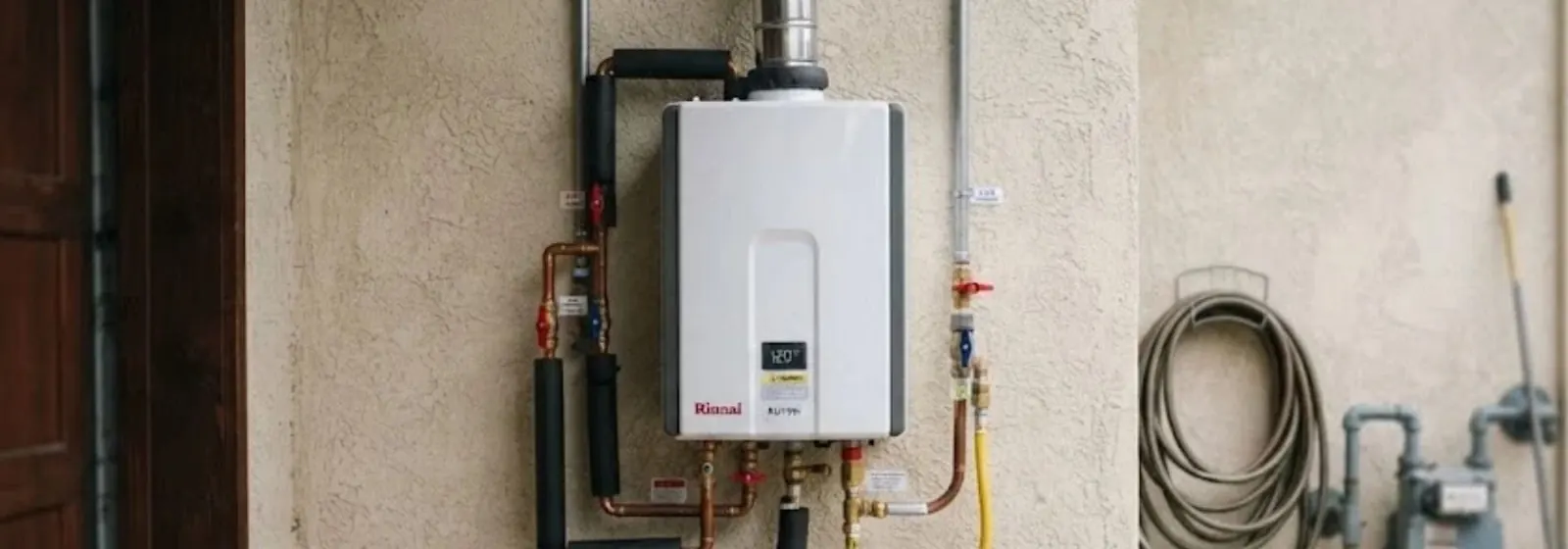
Cleaning a tankless water heater means circulating a mild acid, usually white vinegar, through the heat exchanger to dissolve mineral scale. Done on a schedule, it protects a unit that often lasts 15 to 20 years with maintenance.
The job takes roughly an hour of hands-on time plus soaking. You need a few basic tools and a heater that has service valves installed. This guide covers the gear, the order of steps, the error codes that hint at scale, and the points where a plumber should take over.
What you need before you start
Gather a small submersible or utility pump, two washing machine hoses with female ends, a 5-gallon bucket and about 2 to 3 gallons of undiluted white vinegar. Many makers list their own descaling solution in the manual. Use whichever the manual names.
The pump and hoses connect to the two service ports on the bottom of the unit. These ports sit on the isolation valves, which are brass valves on the cold and hot lines with a small capped drain on each. If your heater has no isolation valves, a plumber can add them in a short visit, and that is worth doing before the first flush.
Also have a flat screwdriver or adjustable wrench for the filter housing, a towel for drips and an old toothbrush for the screen.
The vinegar flush in four moves
Power down
Turn off the unit's power or breaker, close the gas valve to the heater, and shut the cold and hot isolation valves.
Hook up the loop
Connect one hose from the pump to the cold service port, run the other from the hot port into the bucket, and pour in the vinegar.
Circulate
Open both service ports and run the pump for about 45 to 60 minutes, or whatever time your maker specifies.
Rinse and restore
Drain the vinegar, flush with clean water for several minutes, close the ports, reopen the isolation valves and restore power and gas.
Open a hot tap before restoring power so air can leave the lines. Firing the burner on a dry or air-locked unit trips safety shutdowns. The gas valve step is only an on and off turn, and any real gas line work belongs to a licensed plumber.
Symptoms and error codes that point to scale
Code numbers differ between makers, so look yours up in the manual. These patterns are what to expect in general.
Falling hot water flow
Scale narrows the heat exchanger passages and slows output at the tap, most noticeably with two fixtures running.
Temperature swings
The unit hunts for the right firing rate and delivers lukewarm bursts, especially at low flow.
Kettle-like rumbling
Water boiling in a small scaled pocket creates a popping sound as the heater runs.
Overheat or flow error codes
Many makers use a code for exchanger overheating or restricted flow, and those often clear after a descaling.
Ignition failure codes
These can come from scale, but also from gas supply, venting or sensor trouble. Do not keep resetting the unit if one repeats.
The inlet filter screen and why it gets skipped
The small mesh screen at the cold water inlet catches grit before it reaches the exchanger. It is the easiest part to clean and the one most owners forget. Shut the cold isolation valve, unscrew the filter cap, and pull the cylinder out.
Rinse it under a tap and scrub with a soft toothbrush. If you see torn mesh or a crust you cannot remove, replace it with the maker's part. Expect a little water to spill when you open the housing, so keep that towel handy.
A clogged screen mimics a scale problem, since flow drops the same way. Check it again after any water main work in your neighborhood, because disturbed lines can shake loose grit. Cleaning it first sometimes fixes the complaint without any vinegar at all.
Doing the flush yourself or hiring it out
DIY is reasonable when
- Isolation valves are already installed
- You can follow the maker's manual
- The unit is electric or you are comfortable closing gas valves
- No error code repeats after a reset
Call a plumber when
- There are no service valves to connect to
- Valves are seized or leaking
- A code returns right after cleaning
- You suspect a heat exchanger crack or gas issue
A pro flush uses a proper descaling pump and checks combustion, venting and flow at the same visit, and the plumber can serve any address on our service area map. If the exchanger is damaged by years of unchecked scale, ask about tankless water heater service and replacement options.
How often to repeat the flush
The interval depends on your water hardness and how much hot water you use. Harder water or a large household calls for a flush about once a year. Softer water may stretch that to every couple of years.
Start with the maker's recommended interval, then adjust. If you open the exchanger or filter and find heavy scale, shorten the schedule. If it looks clean, you can lengthen it.
A water softener or filtration system reduces scale before it reaches the heater, though it is not a requirement and not every home needs one.
The code behind most plumbing work is a model code such as the UPC or the IPC, adopted with local changes, and the Wheat Ridge Building Division can say which edition governs your project. Any dedicated circuit follows the National Electrical Code (NEC) as adopted locally, so the electrical permit is separate from the plumbing one.
Wheat Ridge note: which Denver Water system feeds you
Wheat Ridge has four water providers listed by the city: Denver Water, Consolidated Mutual, Valley Water and Wheat Ridge Water District. The district buys its water from Denver Water. Denver Water describes a southern collection system at about 75 to 120 mg/L hardness and a northern one at typically 40 to 50 mg/L.
Hardness is also slightly higher in winter, based on a utility article from 2017. The city does not say which provider serves your address, so look at your water bill first. Then phone that provider and ask which Denver Water system feeds your street.
Write the answer on the heater's cover with a marker, along with the date of your last flush. Then pair it with the flush interval in your unit's manual. A home on the 75 to 120 mg/L side deserves a closer look at the filter and exchanger. Plumbers working in nearby towns such as Arvada follow the same logic with their own local hardness figures.
Common questions
Is vinegar safe for a tankless water heater?
White vinegar is the common descaling agent and many makers approve it. Check your manual first, since some require a specific solution and warn against prolonged contact with certain parts.
How long does a tankless flush take?
Plan on about 45 to 60 minutes of circulation, plus time to set up and rinse. Heavy scale may need a second round with fresh vinegar. Spent vinegar that comes out cloudy or full of white flakes is a sign the flush is working.
Can I flush a tankless heater without isolation valves?
Not safely. The valves give you the ports to connect a pump and let you shut the unit off from the house plumbing. A plumber can install them, and they are well worth having.
What does a scale error code usually mean?
It often means the heater sees restricted flow or a high exchanger temperature. The exact code depends on the brand, so read the manual and try a descale and filter cleaning first.
Should Wheat Ridge homeowners flush more often?
It depends on which Denver Water system feeds your street. Ask your district, then compare its answer with the maker's interval and inspect the screen once a year.
Does descaling void my warranty?
Many makers expect regular flushing and may ask for proof. Read your warranty terms, keep notes of the dates, and follow the manual's method.