
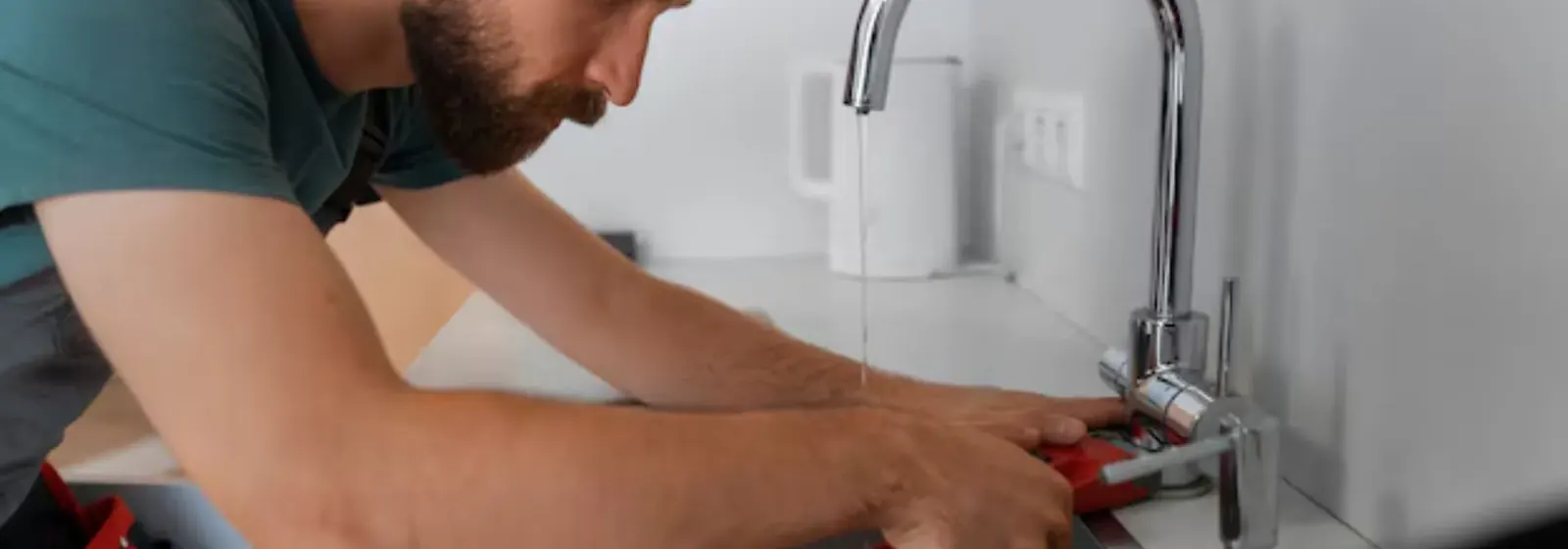
A leaky kitchen faucet wastes water around the clock, and a drip every second can add up to thousands of gallons in a year. The good news is that the parts are small and standardized, and a typical repair takes under an hour once you know which type you own.
The first step is to figure out where the water is coming from: the spout, the base, the handle or the pipes below the sink. This post covers the four internal designs, the cheap fixes that solve most drips, and the signs that say it is time to replace the whole faucet.
Four faucet types and the part that usually fails
| Type | How to spot it | Usual culprit |
|---|---|---|
| Compression | Two separate handles that turn several times | Rubber seat washer or packing O-ring |
| Ball | Single handle over a rounded cap | Seats and springs, or the ball's O-rings |
| Cartridge | Single or double handle with smooth motion | Worn cartridge or its O-rings |
| Ceramic disc | Single lever, cylinder under the handle | Seals at the base of the disc cylinder |
Check the underside of the sink for a model number, or pull the handle and look at what is inside. A photo of the part at a hardware store counter often saves a second trip.
Read the leak location before you take anything apart
Drip from the spout tip
Worn washers, seats, cartridge or disc seals. This is the classic internal valve failure.
Water at the base of the spout
The O-rings around the swivel body, usually two stacked rings that dry out and flatten.
Water under the handle
A loose set screw, a worn packing seal or a cracked cap.
Weak, spraying or split stream
A clogged aerator, not a leak. Unscrew and check it first.
Wet cabinet floor
Often the supply lines or their nuts, a drain connection, or the faucet's shank nut, not the faucet itself.
A cartridge swap in four steps
Shut off water
Close both angle stops under the sink, then open the faucet to relieve pressure and plug the drain with a rag.
Remove the handle
Pry off the cap, back out the set screw with a hex key and lift the handle off.
Pull the cartridge
Remove the retaining nut or clip, note its orientation, and pull the cartridge straight up.
Match and refit
Bring the old cartridge to the store, install the exact match with fresh O-rings and grease, then test slowly.
Use plumber's silicone grease on new O-rings, not petroleum jelly, which can swell rubber. Keep the parts in order on a towel so reassembly is straightforward.
O-rings, aerators and supply lines: the small parts that cause big drips
Spout-base leaks almost always come from the two O-rings around the swivel body. Roll the old ones off, clean the groove and slide on new ones of the same diameter. Coat them lightly with grease so the spout turns without tearing them.
The aerator is the tiny screen at the end of the spout. Unscrew it by hand or with a cloth-wrapped wrench, take out the washer and screen, and soak the pieces in vinegar for an hour. A clean aerator often fixes sputtering that looks like a faucet failure.
Braided supply lines last roughly 5 to 10 years before the connections corrode. If you see rust blooms on the nuts, swap both lines while you are under the sink. Hand-tighten the nuts, then add a quarter turn with a wrench, and no more.
Parts, tools and a sensible shopping list
Most repairs need only an adjustable wrench, a hex key set, a flat screwdriver, a small bucket and a flashlight. A basin wrench helps with the nuts behind the sink that a standard wrench cannot reach.
Buy a small O-ring assortment, plumber's grease and a cartridge or seat kit for your model. Tape the sink drain closed or lay a rag over it, since a tiny screw or spring falls down a drain in a heartbeat. Work in good light and photograph each stage before you disassemble.
Repairing the faucet or putting in a new one
Repair makes sense when
- The leak is at a washer, O-ring or cartridge
- The faucet finish and body are in good shape
- Parts are easy to find
- Only one leak point shows up
Replace when
- The body is pitted or corroded
- Repairs have been repeated more than once
- Parts are no longer made
- You want a pull-down spray or a different layout
Fitting a new faucet involves new supply lines, mounting hardware and sometimes drilling or cutting. Our plumbing installation visits cover that, and a licensed plumber will check the shutoff valves while the cabinet is empty.
When a repair is a job for a plumber
Call for help if the angle stops will not close, the faucet nut is seized, or the cabinet base is soaked from a leak you cannot trace. A stuck shutoff valve that breaks while you force it can turn a small drip into a flood.
Our faucet repair service covers cartridges, valve seats and leaking connections for most kitchen setups. If a hidden leak is suspected, shut the water off at the angle stops and keep the cabinet door open to dry.
Work on supply and drain lines follows a model code such as the UPC or IPC as adopted locally, and the Wheat Ridge Building Division is the source for the edition and any amendments.
Wheat Ridge note: mineral scale and a simple aerator habit
Denver Water describes its southern collection system as moderately hard at about 75 to 120 mg/L and its northern system as softer at typically 40 to 50 mg/L, with hardness slightly higher in winter. The article is from 2017, and it does not say which system supplies Wheat Ridge. Wheat Ridge Water District buys from Denver Water, and the city lists three other providers too.
Hardness is a nuisance, not a health concern. Scale clogs aerators, roughens cartridge seals and leaves a crust on spouts. So make the aerator rinse a routine: unscrew it every few months, check for white grit and soak it in vinegar if you find some.
Ask your water provider for its water quality report, and test your tap if you have questions about hardness. Arvada neighbors to the north publish their own range of 20 to 100 mg/L, so hardness varies even over a few miles.
Common questions
Why does my faucet drip only when the water is hot?
Often the hot side cartridge, seat or washer is worn, or heat has expanded a degraded seal. Replacing the part on the hot side usually ends it.
How much water does a dripping faucet waste?
A steady drip can waste a few gallons a day, which adds up to a surprising figure over a month. Fixing it also lowers wear on the drain and the fixtures.
Can I use any replacement cartridge?
No. Cartridges are specific to the maker and model, and a near match often leaks or binds. Take the old one with you or bring the model number.
Does hard water cause faucet leaks in Wheat Ridge?
Scale can shorten the life of seals and block aerators. The effect depends on which Denver Water system feeds your street, so ask your provider and look for scale on the spout.
Is my kitchen faucet leak covered by home insurance?
Slow leaks and wear are typically maintenance items. Sudden damage from a burst supply line may be covered, so ask your insurer. We serve Wheat Ridge and the nearby towns on our service area page.