
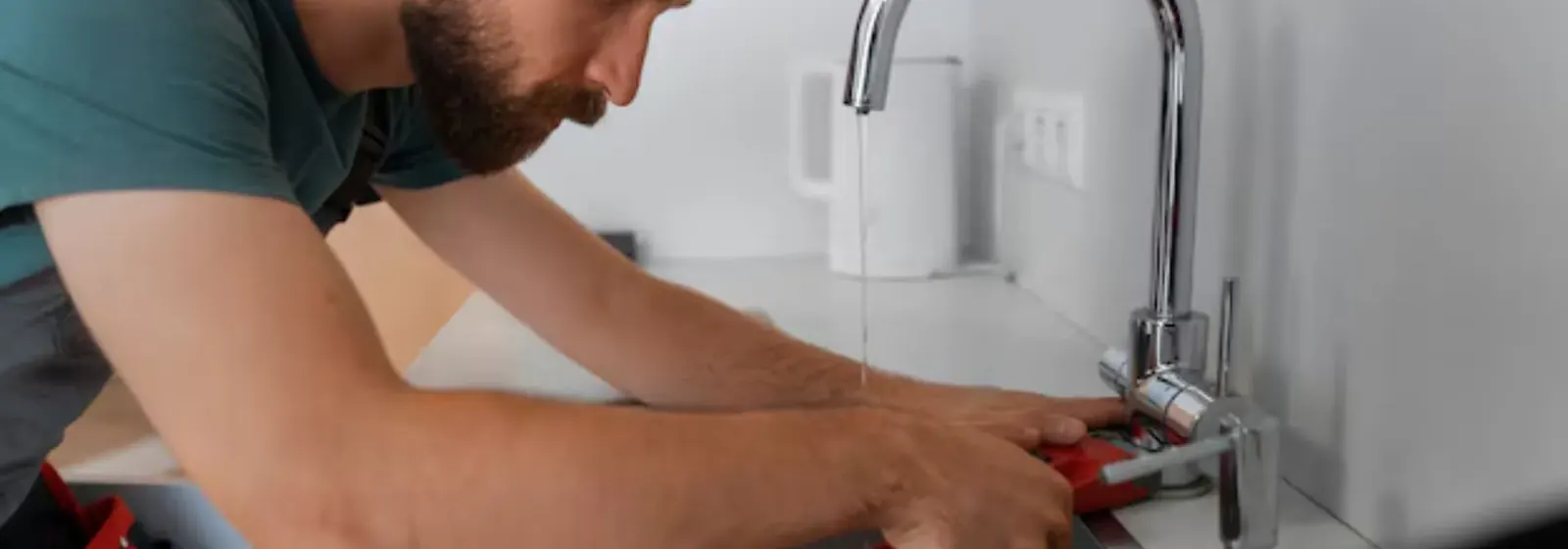
Outside faucet repair covers the spigot on the wall of your house, also called a hose bib or sillcock. Most are cheap to fix when the problem is a worn washer or a loose packing nut, and costly when a split pipe inside the wall goes unnoticed.
Wheat Ridge sits at 5,348 feet on the Front Range, so a faucet that is not shut down properly can turn into a winter repair. This guide starts with the leaks you can see, moves through the frost-free design and the fall shutdown routine, and ends with the warning signs that mean it is time for a plumber.
Match the drip to the part
Drip from the spout when the faucet is off
A worn seat washer at the end of the stem. On a compression style faucet, replacing the washer usually ends it.
Water around the handle when it is on
A loose packing nut or a dried-out packing washer or O-ring under the handle.
Water running behind the wall or inside
A frost-free body that has split, or a joint that failed. Shut off the supply inside and call a plumber.
Spray from the vacuum breaker
The small cap on the spout is an anti-siphon device. It sprays a little when the faucet is on and a hose is attached, but it should not drip when closed.
Handle spins without opening
A stripped stem or a broken handle screw. Replace the handle or the whole stem.
Standard sillcock or frost-free: what you probably have
Standard hose bib
- Short body, valve seat right behind the wall
- Valve sits close to the outside air
- Needs a separate shutoff to drain
- Often found on older and simpler setups
Frost-free sillcock
- Long stem, 6 to 12 inches or more
- Valve seat sits inside the heated wall
- Must tilt slightly downward to drain
- Water inside the pipe does not freeze when hoses are removed
A frost-free body only works when the water drains out of the stem. A hose left attached traps water behind the valve, and that trapped water can still freeze inside the stem and split the pipe. So the design helps, but only with the hose removed.
Replacing the washer on a dripping spout
Shut it off
Close the shutoff valve inside the house, then open the outside faucet to drain the line.
Unscrew the handle
Remove the handle screw, pull the handle, then loosen the packing nut with a wrench.
Pull the stem
Take out the stem and replace the rubber seat washer held by a brass screw at the tip, plus the packing washer.
Reassemble and test
Put it back together, turn the inside valve on slowly, then check the spout and the handle for drips.
If the washer seat inside the faucet body is pitted, a new washer will not seal. Seat dressing tools exist, but replacing the whole faucet is often easier.
Winterizing before the cold sets in
Disconnect every hose, splitter and sprayer from the outside faucets. A hose left on during a freeze keeps water inside the spigot and can burst the pipe behind the wall.
Close the shutoff valve that feeds the outside line. It is usually in the basement, crawl space or a utility room, and may have a small bleeder cap. Open the outside faucet to let the water out, then open the bleeder cap to drain the pipe between the two valves.
Leave the outside faucet open a crack for the season so any remaining water can expand without forcing the pipe. A foam cover is a cheap extra layer over the spigot, but it does not replace shutting it off.
When the pipe itself is the problem
A split frost-free sillcock often shows no sign in cold weather. You find it in spring, when the first hose use sends water through the wall into the basement or the ceiling below. That is a burst pipe repair job, not a washer swap.
Close the interior shutoff right away, and if you cannot find it, close the main. Open the nearby sill-level drain if there is one, and soak up water to protect drywall and flooring. Take photos for your insurance claim.
Replacing the whole sillcock is a short job for a plumber. Replacing the line behind it involves a different scope. Permit rules vary, so ask the Wheat Ridge Building Division before assuming either way, or ask your plumber what the job needs.
Replacing a hose bib that is beyond repair
A faucet with a pitted seat, a corroded body or a cracked barrel is cheaper to replace than to rebuild. Bibs connect to the house line in one of three ways: a threaded joint, a soldered copper sweat joint, or a PEX crimp or push fitting. Match the type you already have.
Threaded swaps are within reach for a careful homeowner with two wrenches and thread sealant. Soldering inside a wall cavity near insulation and framing is a fire risk, and we would leave that to a licensed plumber. A good installer also checks the tilt and adds a new vacuum breaker if the old one is missing.
While the wall is open, ask whether a frost-free model makes sense and whether the shutoff inside needs replacing too. A stuck, never-turned interior valve is a bigger risk than the faucet outside.
What to do before winter damage spreads
Shut the interior valve that feeds the hose bib, then open the outside faucet to drain what is left. If water sprays inside a wall or the ceiling below is wet, turn off the main valve and do not touch nearby outlets with wet hands.
When to call a plumber: a frozen pipe that is bulging or split, a steady drip inside the wall, or any water near electrical boxes. Do not use an open flame to thaw a pipe.
Pipe sizing, venting and trap rules come from model plumbing codes like the UPC and IPC, which each city adopts in its own form, so permit rules vary and the Building Division has the answer.
Quick seasonal checklist for outside faucets
| When | Task | Why |
|---|---|---|
| Spring | Open slowly and check the wall and ceiling inside | Finds a winter split before it floods |
| Summer | Tighten the packing nut and inspect washers | Stops slow drips that waste water |
| Early fall | Remove hoses, drain the line, close the shutoff | Protects the pipe from trapped water |
| Anytime | Watch the water meter with everything off | A moving dial can mean a hidden leak |
Wheat Ridge note: elevation and the winter shutoff
Wheat Ridge sits at 5,348 feet at the foot of the Rockies, so winter shutoff matters on the Front Range. We do not give freeze dates or ground depths here, because they vary by year and by the exposure of each wall. The safe habit is to make the fall shutoff a calendar reminder, not a reaction to the first forecast.
If you are not sure whether your faucet is frost-free, look at the length of the stem and where the shutoff sits. Ask your plumber to point out the interior valve on your next visit. Wheat Ridge has four water providers, so also check your bill for your provider's contact information.
A leaking faucet adds to your metered water use. Ask your provider how outdoor water use is handled, and check seasonal watering rules. Arvada homeowners just to the north have the same shutoff routine to follow.
Common questions
How do I know if my outside faucet is frost-free?
Look for a long barrel behind the spout and a slight downward tilt. Pull the handle off and you can see the long stem. If it looks like a short stub, it is probably a standard bib that needs a separate shutoff.
Can I just leave my hose attached all winter?
No. A trapped column of water can freeze and split the pipe inside the wall, even on a frost-free model. Remove the hose and drain the line.
Why does my outside faucet only leak when the hose is on?
That usually points to the packing under the handle or a bad hose washer. Tighten the packing nut a quarter turn first, then replace the packing washer if it persists.
Will insurance cover a burst outside faucet?
Sudden damage from a burst pipe may be covered, while slow leaks and maintenance usually are not. Ask your insurer, and document the damage with photos.
What does a Wheat Ridge homeowner do about a faucet leak inside the wall?
Shut off the interior valve or the main, then call a plumber. We serve Wheat Ridge and nearby towns listed on our service area page, and the 24/7 emergency line is open for active leaks.