
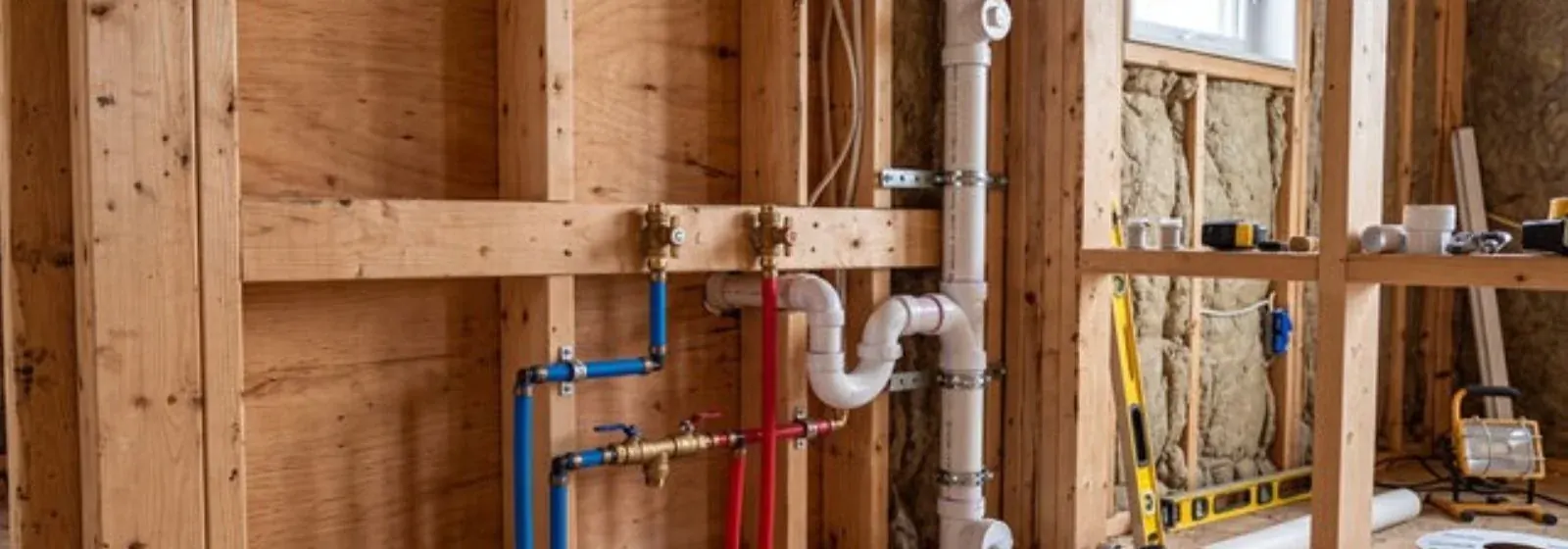
PEX plumbing installation means running cross-linked polyethylene tubing for the hot and cold water supply lines in a house. The tubing bends around corners, comes in long coils and joins with small metal or poly fittings. A whole-house repipe can often be roughed in faster than the same job in rigid pipe.
PEX is not magic, and it is not right for every spot. It has limits around sunlight, tight bends and certain fittings. Local rules also decide who can install it and what inspection follows.
Below you will find the three PEX grades, the two common joining methods, a side-by-side look against copper and CPVC, and a plain account of the permit and licence picture in Wheat Ridge.
PEX-A, PEX-B and PEX-C: what the letters mean
The letters describe how the polyethylene is cross-linked during manufacturing, not a quality ranking. PEX-A is the most flexible and has a shape memory, so a kink can often be relaxed with a heat gun. PEX-B is a bit stiffer and typically resists chlorine well. PEX-C sits in between on flexibility and is less common in supply houses.
Flexibility changes how you route a run. PEX-A turns a corner in a stud bay with a gentle sweep, while PEX-B often needs an elbow or a bend support to avoid a kink. Minimum bend radius is printed on the tubing or its spec sheet, and a typical rule is around six times the outside diameter.
Color is only a label. Red is meant for hot, blue for cold and white or gray for either, but the color does not change what the tubing can handle. Always check the printed marking for the rated pressure and temperature, plus the standard it meets.
Crimp rings vs cold expansion fittings
Crimp or clamp rings
- Works on PEX-A, B and C
- Uses a copper crimp ring or a stainless clamp
- Needs a go/no-go gauge to confirm every joint
- Fittings are barbed and slightly restrict flow
- Tooling costs less for a single job
Cold expansion
- Made for PEX-A only
- A tool stretches the pipe end and a ring, then the tubing shrinks back
- Joint is tight and wide open inside
- Takes a few seconds of waiting per fitting in cold rooms
- Tooling is pricier but the joints are consistent
Both methods are accepted by manufacturers when you follow the instructions exactly. Never mix a tool from one brand with fittings from another, since the dimensions are matched. Push-to-connect fittings also exist and work for repairs, but plenty of installers avoid burying them in walls.
PEX vs copper vs CPVC for household supply lines
| Factor | PEX | Copper | CPVC |
|---|---|---|---|
| Flexibility | Bends around corners, fewer fittings | Rigid, a fitting at every turn | Rigid and brittle with age |
| Joining | Crimp, clamp or expansion | Soldered or press fittings | Solvent cement |
| Freeze tolerance | Often swells instead of splitting, fittings are the weak point | Can split when ice forms | Can crack when frozen |
| Sunlight | Degrades with UV, must stay covered | Unaffected | Can yellow and weaken in sun |
| Where it shines | Remodels, long runs, manifold systems | Exposed runs, durable service | Budget hot and cold lines in dry spaces |
Treat that table as a starting point, since product ratings differ by brand and code. Freeze tolerance in particular is a bonus, not a plan. A frozen PEX line can still leak at a fitting, so insulate runs near exterior walls and keep outdoor lines drained.
Manifolds, home runs and fittings in a PEX layout
A manifold is a distribution block that sends a dedicated PEX line to each fixture. Instead of branching from a trunk, every sink, shower and toilet gets its own run from the block. Pressure stays steadier when someone flushes while another person showers, and you can shut off a single fixture at the manifold.
The trade-off is more tubing and more holes through framing. Many plumbers use a hybrid layout instead, with a trunk and branch system for the main run and a short manifold for a bathroom group. Either way, the manifold should sit where you can reach it, not behind a finished wall.
Fittings come in brass, bronze, poly and stainless. Brass is common and long-lived, though some brass can corrode in aggressive water, so ask the supplier about the grade. Tubing should never touch sharp edges, and a plastic sleeve or nail plate protects it where it passes through studs. New fixtures and branch lines added during a remodel fall under plumbing installation work, and the same tubing rules apply.
Installers in Colorado work to a model plumbing code, commonly the UPC or IPC family, with local amendments, so the permit desk is the place to confirm what applies at your address.
Where PEX installations go wrong
Too much sun
Tubing left outdoors or near a window degrades under UV. Most makers limit exposure to a few months, so cover it or keep it boxed until it goes in.
Tight bends
A kinked section restricts flow and can fail later. Use a bend support or an elbow fitting when the radius is too small.
Joints in the wrong place
Putting a fitting inside a closed wall without access makes any future leak a demolition job.
Mixing tools and fittings
A crimp tool for one ring size will not seal another. Wrong tooling makes joints that pass a quick glance and fail under pressure.
Skipping the pressure test
Cap the system and test it with air or water for the time your inspector requires before the walls close.
Wheat Ridge note: licences, permits and the homeowner exception
Supply piping falls under licensed plumbing work, and the licence picture has two layers. The Colorado State Plumbing Board names the Residential, Journeyworker and Master Plumber licences and offers a public lookup so you can check a name before you hire. The City of Wheat Ridge adds a Class 4 plumbing contractor licence that covers sanitary plumbing and potable water supply piping, and the applicant must hold a State Master Plumber and a State plumbing contractor licence.
Permits run through the Wheat Ridge Building Division and its OpenGov portal. The state permits page says a hired contractor is responsible for obtaining the permit, and that it is a violation of state law for an unregistered person, other than the homeowner, to install a plumbing project on the property.
That state page also notes Jefferson County has its own local inspection program, and an adult must be present for inspections of occupied dwellings. Permit rules vary, so ask the Wheat Ridge Building Division before you buy tubing.
Our Arvada plumbing page explains the separate rules just north of the city line, and the service area page lists the other towns we reach. Each building department has its own process, so a permit approved in one town does not carry into another.
Common questions
Is PEX approved for drinking water?
Yes, PEX tubing sold for potable supply carries a marking that shows it meets the relevant standard. Check the printed text on the pipe, since not every PEX product is rated for drinking water. Ask the building department if your jurisdiction restricts a particular type.
Can PEX survive a freeze?
Often it expands without splitting, but that is not the same as being freeze-proof. Fittings and the connection to rigid pipe are the usual failure points. Insulate runs near exterior walls and drain outdoor lines before a hard freeze.
Can I run PEX outdoors or in an attic?
Only if the tubing is protected from sunlight and insulated against cold. UV breaks down PEX, and most manufacturers cap exposure. A sleeve and foam insulation are typical protection. Roof and attic work carries fall risk, so a plumber may be safer.
Can PEX connect to my existing copper or galvanized pipe?
Yes, with transition fittings made for the pipe type you are joining. Galvanized to copper or brass contact can corrode where dissimilar metals touch, so a dielectric or brass transition is the usual answer. A plumber can check what you have before the cut.
Do I need a permit for PEX in Wheat Ridge?
The city says a building permit is required for new construction, additions or alterations, and permits go through the Building Division. Plumbing is not specifically listed on that page, so permit rules vary. Call the permit desk at (303) 235-2855, option 1, before you start.
Is PEX cheaper than copper to install?
The tubing usually costs less and goes in faster, but the tooling and the labor depend on the layout. A manifold system uses more tubing than a trunk system. For a clear price based on your house, call (303) 552-3896 and we will explain it before work starts.