
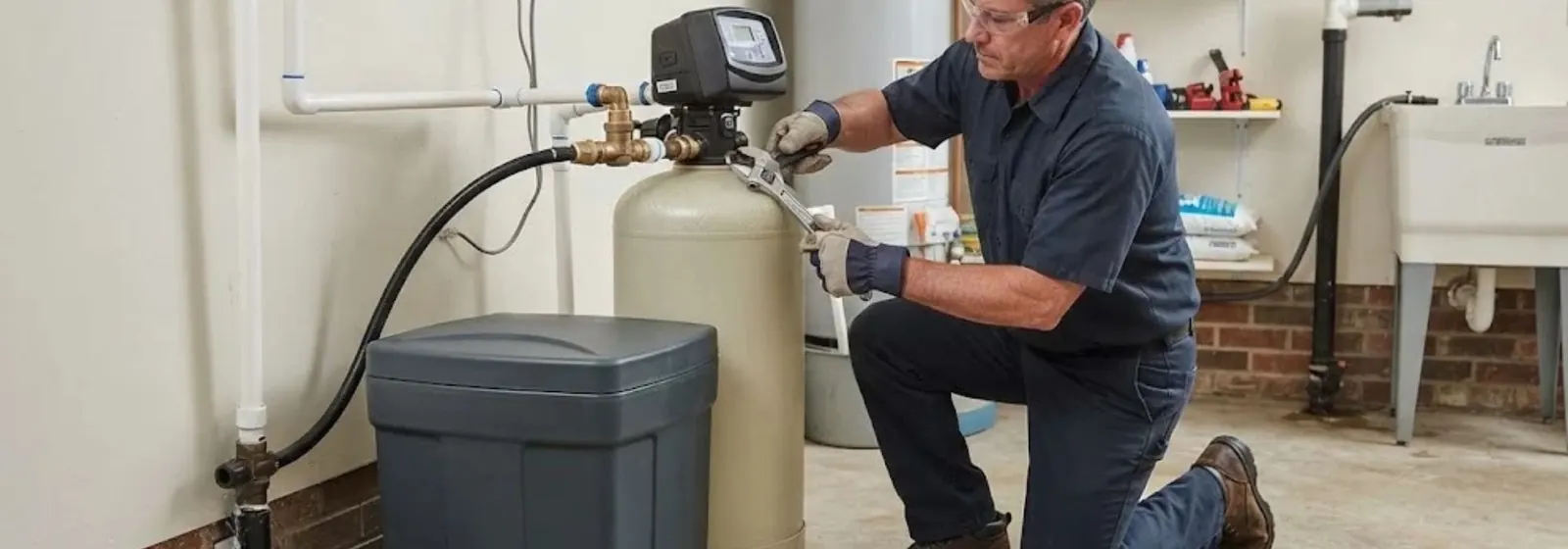
A water filtration system for a kitchen faucet cleans the water you drink and cook with, usually at one tap. It does not treat the whole house, and it does not soften water. That distinction decides which style makes sense.
The four common choices are an under-sink carbon filter, a reverse osmosis system, a filter that clips onto the faucet and a countertop unit. They differ in what they remove, how much room they take, how often parts need changing and whether the plumber needs to drill your sink or counter.
Below you will find a comparison table, the certification marks worth looking for, the installation details for a dedicated faucet, and a local note on finding your water quality report. If your faucet itself leaks or sputters, a faucet repair visit may come first.
Four kitchen filter types side by side
| Type | Best for | Watch out for |
|---|---|---|
| Under-sink carbon block | Better taste and odor, chlorine, some contaminants depending on the cartridge | Needs cabinet space and regular cartridge changes |
| Reverse osmosis (RO) | Dissolved solids and a wider list of contaminants, drinking and cooking water | Slow storage tank, wastewater to the drain, membrane replacement |
| Faucet-mounted | Renters and quick, low-cost taste improvement | Fits only some faucets, slows flow, small cartridge |
| Countertop pitcher or unit | No plumbing changes, easy to move | Sits on the counter, refilled by hand, limited volume |
None of these is the best for everyone. A renter with a pull-out spray faucet is likely to land on a different answer than a homeowner with a spare cabinet and a dedicated drinking tap.
What a kitchen filter does and does not remove
Activated carbon is the workhorse. It adsorbs chlorine, many taste and odor compounds and some organic chemicals. A carbon block with a fine pore size can also catch particles, and some cartridges are designed to reduce lead. That depends on the specific cartridge and its certification.
Carbon alone does not soften water. Hardness comes from dissolved calcium and magnesium, and a typical carbon cartridge leaves them in. Reverse osmosis pushes water through a membrane that rejects most dissolved minerals, so an RO tap will taste different from a carbon-filtered one.
No filter removes everything. Each is tested against a defined list of contaminants and reduction levels, and a filter with a weak spot for one contaminant can be excellent at another. That is why certifications matter more than marketing words like pure or purified.
Under-sink carbon or reverse osmosis: what living with each is like
An under-sink carbon system is the simpler install. One or two canisters hang on the cabinet wall, a tube runs to a small faucet, and the cartridges twist out for changes. Flow is fast, there is no wastewater, and the cost of ownership is mostly the replacement cartridges.
Reverse osmosis adds a membrane, a storage tank that holds a few gallons and a drain connection. The system sends rejected water to the drain while it fills the tank, so you will hear a trickle after you draw water. Many RO units also include a carbon pre-filter and a post-filter, and each stage has its own change interval.
Choose RO when you want the broadest reduction of dissolved solids and accept the extra parts. Choose carbon when taste and chlorine are the main complaints. In either case, ask a plumber to check your shutoff valves and supply lines first, because a corroded angle stop is a poor foundation for a new filter.
Installers in Colorado work to a model plumbing code, commonly the UPC or IPC family, with local amendments, so the permit desk is the place to confirm what applies at your address.
Marks to look for on the package
Look for an independent mark and then read what the data sheet claims the filter reduces.
NSF/ANSI 42
Covers aesthetic effects such as chlorine taste and odor and some particles.
NSF/ANSI 53
Covers health-related reductions, such as lead and certain other contaminants, for the ones the product lists.
NSF/ANSI 58
Covers reverse osmosis systems and their listed reductions.
NSF/ANSI 401
Covers some emerging contaminants and incidental compounds, for products that list them.
A performance data sheet
The sheet shows which contaminants were tested. A mark with no listed claims tells you very little.
Adding a dedicated filtered-water faucet
Choose the hole
Many sinks have a spare hole or a sprayer opening. If not, a stainless sink can be drilled, but granite and quartz need a stone specialist.
Mount the faucet
The small faucet is set with a gasket and a nut under the deck, with room underneath for the tubing connection.
Tap the cold line
A saddle valve or tee on the cold supply feeds the filter, and a shutoff lets the cartridge be changed without turning off the kitchen.
Flush and test
Run the filter for the time the maker specifies, check every fitting for drips, and then taste the water.
Plan the tubing path before you buy. A tight cabinet with a garbage disposal and a dishwasher line leaves little room, and an RO tank may need to sit off to the side or in an adjacent cabinet.
Filter life and when to change cartridges
Signs a cartridge is spent
- Taste or odor returns
- Flow from the filter tap drops
- The maker's change date or gallon limit has passed
- An indicator light or counter says so
Good habits
- Write the install date on the filter housing
- Replace on time even if the water still looks fine
- Sanitize the housing when the maker advises
- Check the fittings for slow leaks during each change
Cartridge life varies a lot by model and by how much water you use. Follow the instructions that came with your filter, not a generic schedule.
Wheat Ridge note: find out who supplies your water
The City of Wheat Ridge lists four water providers: Denver Water, Consolidated Mutual, Valley Water and Wheat Ridge Water District. The city page does not say which serves a given address, so check your water bill. Then ask that provider for its annual water quality report, because the report shows what your filter actually needs to handle.
For a nearby comparison, the City of Arvada publishes its annual water quality report and says its water averages 84 mg/L of hardness. That number applies to Arvada, not to your Wheat Ridge address. It is a handy reference point when you compare your own report, which may list different values.
Denver Water notes that hardness is not a health concern but causes household nuisances. It also advises customers to research any device and contact the utility before buying, because sales scams have occurred. Use the report and a test of your tap to decide whether you need a filter, a softener or neither. Our water softener and filtration service covers whole-house options.
Common questions
Is an under-sink filter better than a faucet-mounted one?
For most households, yes, because it holds more media, keeps flow normal and avoids cluttering the faucet. Faucet-mounted units suit renters who cannot modify plumbing.
Does a kitchen filter soften water?
No. A standard carbon filter leaves hardness in place. Reverse osmosis removes most dissolved minerals at one tap, but it is not a whole-house softener.
Will a filter protect my dishwasher and water heater from scale?
Not a kitchen-tap filter, since it only treats one line. Scale control needs a whole-house conditioner or softener, and Denver Water says many customers may not need one.
Where do I get my Wheat Ridge water quality report?
Check your bill to see which of the four providers serves your address, then ask that provider for the annual report. The Wheat Ridge Water District office is at 6827 W 38th Ave, (303) 424-2844.
Do landlords usually approve filter installs?
Drilling a countertop or tapping a line usually needs written approval. Property managers can call (303) 552-3896 to arrange a clear price first. Tenants can use pitchers or faucet-mount units instead.
Can you install filters outside Wheat Ridge?
Yes. Our plumbers serve Wheat Ridge and nearby towns, including Arvada.