
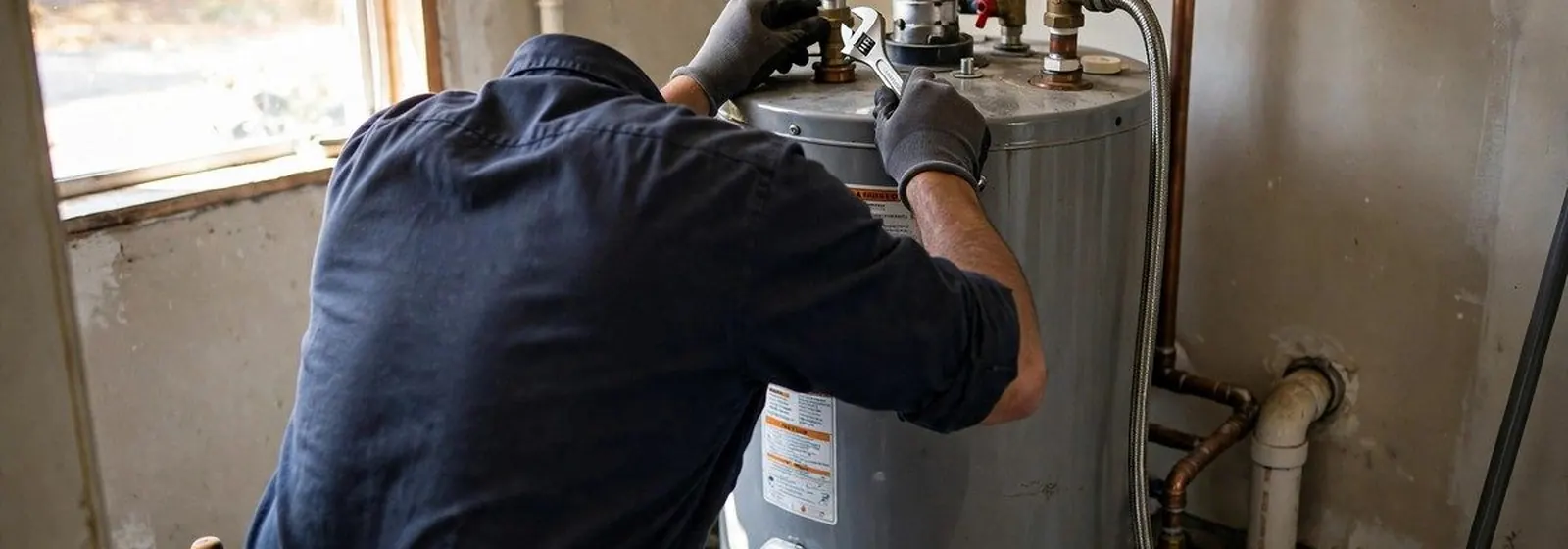
Water heater element replacement is one of the more manageable repairs on an electric tank. The part is a metal rod that screws into the side of the tank, it costs little compared with the heater, and swapping one takes about an hour for someone who has done it before.
The catch is that you are working with 240-volt power and a tank full of water. A wrong guess about the failed part wastes a weekend, and a skipped safety step can hurt you. This post walks through how the parts work, how to test them, and the signs that mean the tank itself is finished.
How the two elements and two thermostats share the work
A standard electric tank holds two screw-in heating elements, one near the top and one near the bottom. Each has its own thermostat sitting behind a metal cover plate, usually under a layer of insulation. A reset button with a red cap lives on the upper thermostat, and it trips when the tank overheats.
The upper element heats first. It warms the top third of the tank until that thermostat is satisfied, then the power switches to the lower element, which heats the rest. Because of this hand-off, the two failures look different from each other.
A dead upper element or upper thermostat usually means no hot water at all. A dead lower element means you get a short burst of hot water that runs out fast, since only the top third of the tank is being heated.
What each failure tends to look like
Use these patterns as a first sort, not a diagnosis. A multimeter test is what actually confirms the part.
Hot water gone completely
Often the upper element, upper thermostat or the high-limit reset. Press the red reset button once before assuming anything has failed.
Hot for a few minutes, then cold
Typically the lower element. Only the upper section of the tank is being heated, so the supply drains quickly.
Water never gets very hot
A thermostat set low, a weak element or a lower thermostat that is not calling for heat.
Breaker trips when the heater runs
An element with a short to the tank wall. Leave the breaker off and have it checked.
Rumbling or popping noises
Sediment baked onto the elements. The noise is steam bubbles escaping from under the scale.
Testing an element with a multimeter, step by step
Kill power
Switch off the double-pole breaker, then confirm the heater is dead with a non-contact voltage tester at the wires.
Open the cover
Remove the access panel and insulation, then fold the insulation back and unscrew the plastic safety shield if there is one.
Isolate the element
Disconnect the two wires from the element terminals and set your meter to ohms.
Read the result
A good 4,500-watt element typically reads about 10 to 14 ohms. A reading of zero or no reading at all means a bad element, and a reading from a terminal to the tank wall means a short.
If the elements pass, the thermostat or the wiring is the next suspect. Testing a thermostat means measuring live voltage, and that is where we draw the line for homeowners. Call a licensed plumber or an electrician rather than probing a powered 240-volt circuit.
Electric tank, gas tank or tankless: where elements apply
| Heater type | Has elements? | What fails instead |
|---|---|---|
| Electric tank | Yes, two screw-in elements | Elements, thermostats, high-limit switch |
| Gas tank | No | Thermocouple, pilot assembly, gas control valve |
| Electric tankless | Yes, but internal heating coils | Coils, flow sensor, control board |
| Gas tankless | No | Igniter, flame sensor, heat exchanger scale |
Gas heaters have no elements at all, so a gas tank with no hot water is a different repair. If you smell gas, leave the building and call 911 from outside. Gas work is never a DIY project.
Sediment, hard water and why the lower element fails first
Minerals settle out of heated water and pile up at the bottom of the tank. The lower element sits right in that layer. It gets buried in scale, overheats against it and burns out sooner than the upper one.
A scaled element may still test good, yet heat poorly because the coating insulates it from the water. Flushing a few gallons from the drain valve every year helps slow this. Tanks that have gone many years without a flush can have drain valves clogged with sediment, so do not force a stuck one.
Tank water heaters often last roughly 8 to 12 years. If yours is near the top of that range and the lower element has failed, a new element may buy only a short extension. That is a fair moment to compare repair against a full tank replacement.
Safety steps before touching an electric water heater
Turn the breaker off and confirm the power is dead with a tester before any panel comes off. Do not rely on the thermostat setting. Water at the tank can scald, so let the heater cool and open a hot tap to relieve pressure before draining.
When to call a plumber: scorch marks, a tripping breaker that resets and trips again, water pooling at the base, or any doubt about working near live wiring. Do not run an electric element dry.
Replacing the element: the parts of the job that go wrong
After testing, you must drain the tank below the element level before unscrewing it. Turn off the cold supply, open a hot tap upstairs so the tank can vent, and run a hose from the drain valve to a floor drain or outside.
Most elements use a 1-1/2 inch socket and unthread counter-clockwise. A seized one is common on older tanks, and cranking too hard can crack the tank threads. Match the new element to the old one: wattage, voltage, and screw-in or bolt-in style.
Refill the tank fully and let air bleed from the hot tap before restoring power. Powering an element while it is out of water burns it out in seconds, which is a classic cause of a brand-new element failing.
If the tank leaks around the element opening, or a thermostat has failed, it may be time for professional water heater repair instead of another round of parts.
Installers in Colorado work to a model plumbing code, commonly the UPC or IPC family, with local amendments, so the permit desk is the place to confirm what applies at your address. Any dedicated circuit follows the National Electrical Code (NEC) as adopted locally, so the electrical permit is separate from the plumbing one.
Wheat Ridge note: Denver Water hardness and your element
Denver Water has described two collection systems with different hardness. The southern system is moderately hard at about 75 to 120 mg/L, and the northern system is softer at typically 40 to 50 mg/L. The utility also notes hardness runs slightly higher in winter. That article dates from 2017, so treat it as background.
Wheat Ridge is served by four water providers, including the Wheat Ridge Water District, which buys its water from Denver Water. The city does not say which provider covers a given address, so check your bill. Then ask which system feeds your street, since higher hardness means faster scale on the lower element.
If your area is on the harder side, plan an annual tank flush and check the element sooner when hot water fades. Plumbers who serve the wider area, including Arvada to the north, see the same scale pattern wherever the water is harder.
Common questions
Can I replace a water heater element myself?
Many handy homeowners do, as long as the breaker is off, the voltage is confirmed dead and the tank is drained below the element. If any step feels uncertain, or the wiring looks scorched, call a licensed plumber.
Do I replace one element or both?
If one has failed from age or scale, the other is usually close behind. Replacing both while the tank is already drained saves a second round of draining and refilling.
How do I know if it is the element or the thermostat?
Test the element with the meter first, since that part is safe once power is off. A good element with no heat points to the thermostat or a tripped high-limit reset, which needs live testing by a professional.
My gas water heater has no hot water. Is it an element?
No, gas heaters do not have elements. The usual suspects are the pilot, thermocouple or gas control valve. If you smell gas, leave the house and call 911 from outside.
Does Wheat Ridge water shorten element life?
Hardness is the factor, and it depends on which Denver Water system feeds your street. Ask your water provider, test your tap, and flush the tank yearly if the water leans hard.
When is replacing the whole water heater smarter?
When the tank leaks, the heater is past roughly 10 to 12 years, or the lower element keeps burning out. A leaking tank cannot be repaired at all. See the towns we serve if you are outside Wheat Ridge and want to confirm coverage.